
Couples: How to Avoid Losing 20% to 50% of Your Wedding Venue Deposit

Most venues ask for a deposit between 20% and 50% of your total contract, with flat-dollar amounts ranging from a few hundred to several thousand dollars depending on the property. Treat that first payment as at least partially nonrefundable unless your contract says otherwise, because refund odds hinge on how much notice you give and whether the venue can rebook your date. Before you sign anything, read the cancellation clause twice and seriously weigh wedding cancellation insurance.
TL;DR:
Most venue deposits range from 20% to 50% of the total contract, reflecting demand, guest count, and included services, with higher rates for peak seasons or popular dates.
Deposits are typically due within days of signing, with final payments due one to three months before the wedding, and flexible schedules are sometimes available for bookings made far in advance.
Refundability heavily depends on contract language, with most deposits being nonrefundable unless cancellation occurs well in advance and specific clauses are favorable; dispute options are limited.
Key contract terms to examine include liquidated damages and rescheduling policies, which determine how deposits are handled if plans change or dates are shifted.
Using a credit card for payment and purchasing wedding cancellation insurance can provide significant protection for deposits, especially for high-dollar bookings or unforeseen venue closures.
Table of Contents
How Much Is a Venue Deposit, Really?
Venues price deposits as either a percentage of your total contract or a flat fee, and which one you get often says something about how the venue runs its business. A percentage-based deposit scales with your guest count and package, which is why high-demand venues, especially those booking out popular Saturdays a year in advance, tend to land at the higher end of that a range from about 20% to 50%.
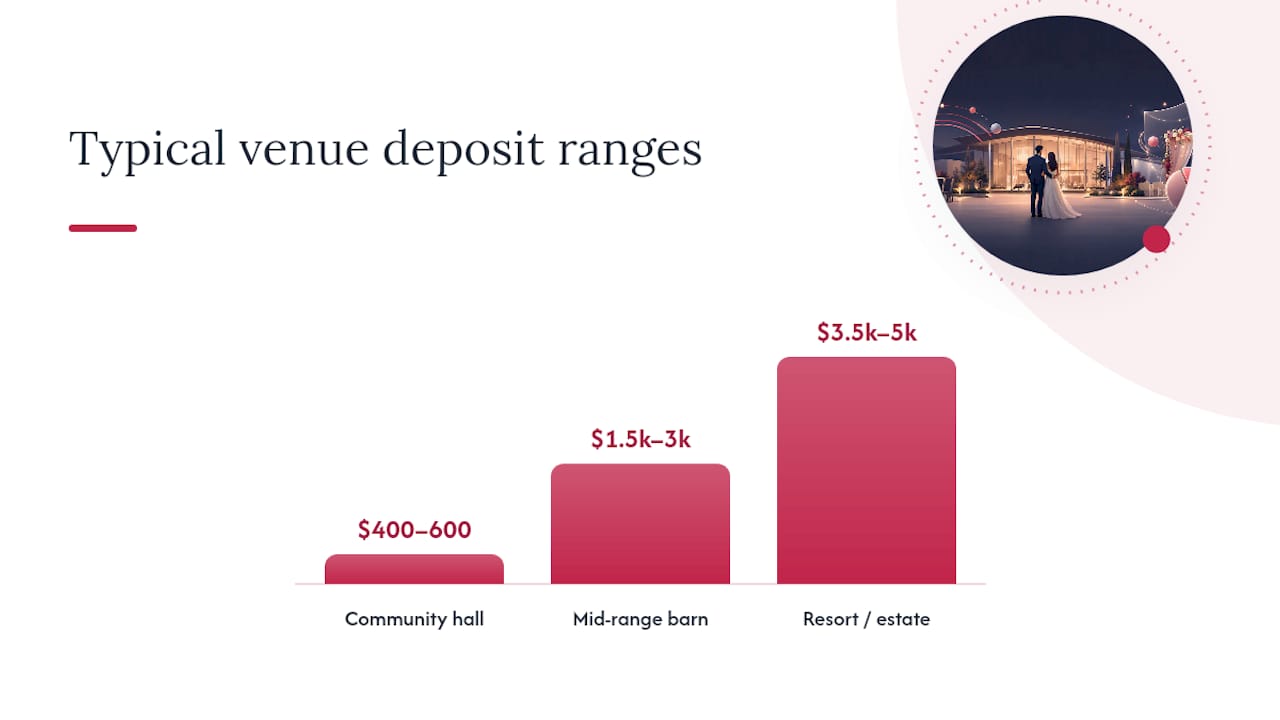
Here’s how that translates to real dollars. A modest community hall renting for $2,000 might ask for a $400 to $600 deposit. A mid-range barn venue running $6,000 to $9,000 for the weekend could require $1,500 to $3,000 upfront. A high-end resort or estate charging $20,000 or more might set a flat deposit of $3,500 to $5,000 just to hold the date.
A few factors push that number up or down:
Season and day of the week. Saturday dates in June or October usually carry higher deposits than a Tuesday in February.
Guest count. More people means more staffing, tables, and cleanup, and venues price that risk into the deposit.
Included services. A venue that bundles catering, bar staff, or day-of coordination will typically ask for more upfront since it’s committing more resources to your date.
Venue type. All-inclusive estates tend to set flat deposits; barns and community spaces more often use percentages.
When Are Deposits and Final Payments Due?
Almost every venue follows the same basic rhythm, even if the exact numbers shift from contract to contract:
Deposit at signing. This locks your date and is usually due within days of signing, sometimes with the contract itself.
One or two intermediate payments. Many venues split the middle portion into a payment at the six-month or three-month mark to spread out the financial load.
Final balance. Venues commonly require the remaining balance between one to three months before the wedding, and plenty lean toward the earlier end of that window so they have time to finalize staffing.
If that final balance lands during an expensive month, ask about splitting it into two smaller payments instead of one lump sum. Venues booked far in advance, sometimes 18 months or more, will occasionally accept a smaller initial deposit since they have more runway to fill the date if you cancel. Always get any adjusted schedule in writing before you rely on it.
Are Wedding Venue Deposits Refundable?
Contract language does most of the heavy lifting here, and the words matter more than couples expect. A refundable deposit gets returned in full if you cancel within the terms outlined. A partially refundable deposit returns some portion, often the amount above what the venue considers its administrative or holding cost. A nonrefundable deposit, the most common structure, is kept regardless of when you cancel.
Venues typically set deposits at about 20% to 50% of the total estimated cost, and whether that money comes back to you depends far more on contract wording than on the percentage itself.
Timing changes your odds even under a nonrefundable label. Cancel eight months out and a venue may still credit part of your payment because it has a realistic shot at rebooking the date. Cancel six weeks before the wedding and that same venue has little incentive to budge.
If a venue keeps your deposit and you believe the amount is unfair, your practical options are limited:
Dispute the charge through your credit card issuer if you paid that way.
File in small claims court for lower-dollar disputes, which doesn’t require a lawyer.
Avoid full litigation as a first move. It’s expensive, slow, and rarely worth it for a deposit-sized loss.
The Contract Clauses That Matter More Than the Deposit Itself
The percentage you put down matters less than what the contract says happens when plans change. Two terms decide most of that: liquidated damages and penalty. A liquidated damages clause is legally sound when it reflects a reasonable estimate of what the venue actually loses if you cancel. If the clause instead functions as punishment, unrelated to real financial harm, some courts won’t enforce it.
Rescheduling terms deserve equal attention. Some venues treat a date change as a simple transfer and roll your deposit forward with no penalty. Others treat it as a full cancellation and rebooking, which can trigger new fees entirely.
Before signing, ask for written answers to these questions — our guide on Cómo elegir fotógrafo de boda can help you prepare the right questions.
Is the deposit refundable, partially refundable, or nonrefundable, and does that status change over time?
Does the deposit apply toward your final bill, or is it a separate holding fee?
What happens if you need to reschedule instead of cancel?
What specific deductions can be taken from the deposit, and how are they calculated?
Pro Tip: Ask the venue directly how they calculate cancellation damages. A vague answer is a signal to negotiate harder or walk away.
How to Protect Your Deposit Before You Ever Need To
You have more leverage before signing than after. Booking well outside peak season, staying flexible on your exact date, or choosing a weekday can all lower the deposit a venue asks for. Some venues will also accept a smaller deposit if you book far enough in advance that they have low risk of losing the date to another couple.
Once you’re ready to pay, use a credit card rather than cash or a bank transfer. It gives you a dispute path if something goes wrong, and it’s one of the simplest protections available. Keep every receipt, signed agreement, and email confirmation in one folder, digital or physical, so you’re never scrambling for proof later.
For real financial protection, wedding cancellation insurance is worth serious consideration, especially once your total deposits climb into the thousands. These policies commonly reimburse nonrefundable deposits and cover losses from vendor no-shows or covered emergencies that force a postponement.
Negotiate deposit size before signing, not after.
Pay by credit card whenever the venue allows it.
Buy cancellation insurance if your combined deposits represent real money you can’t afford to lose.
Pro Tip: Photograph or scan your signed contract the day you sign it. A phone left on a table shouldn’t be the only place your proof of payment exists.
What Happens if the Venue Closes Before Your Wedding?
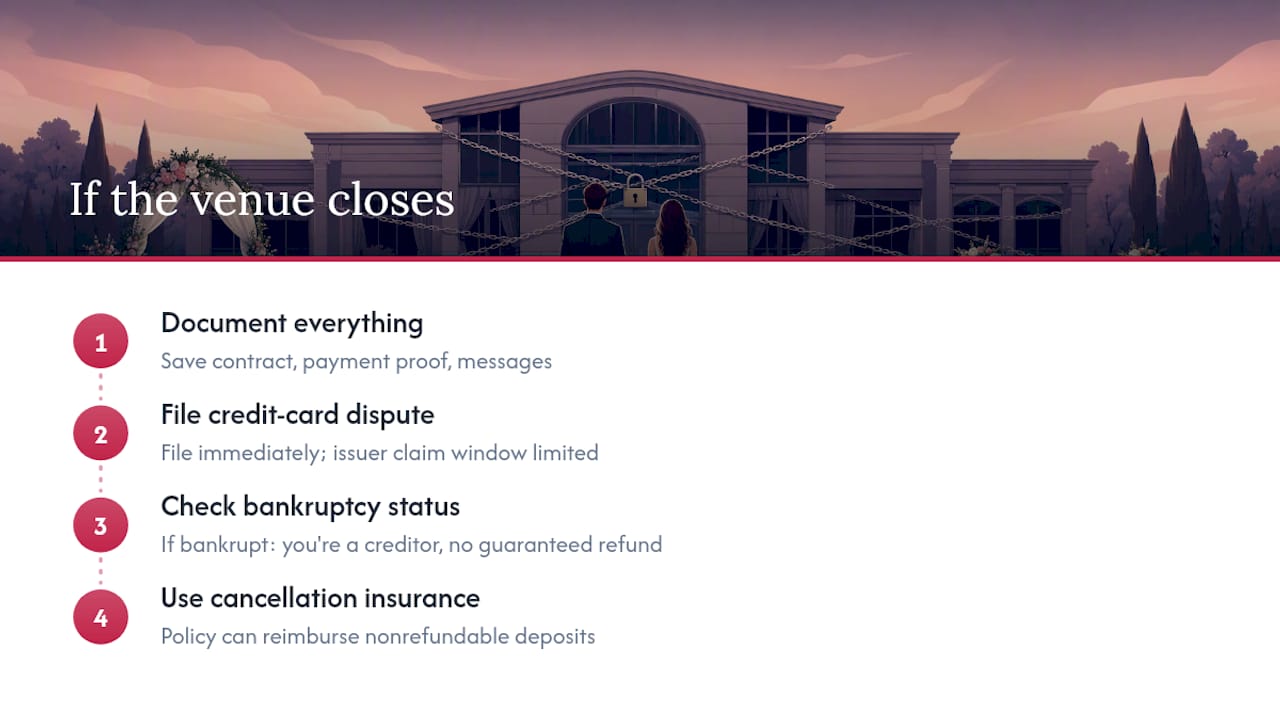
If a venue shuts down before your date, treat your deposit the same way you would any unresolved debt: document everything and act fast. File a credit card dispute immediately if that’s how you paid, since most issuers have a claim window that closes within a set number of months. Check whether the venue filed for bankruptcy, which puts you in line with other creditors rather than guaranteeing a refund. This is exactly the scenario cancellation insurance is designed for, since a policy that reimburses nonrefundable deposits doesn’t care why the venue can’t deliver.
Mountain View Menagerie’s Approach to Deposits
At Mountain View Menagerie, the deposit secures your exact date, our staffing plan, and the setup details that come with your package, no guesswork involved. We work with couples on rescheduling and credit toward a new date rather than treating every change as a loss when circumstances allow. Clear terms up front mean fewer surprises later.
— James
Why Couples Choose Mountain View Menagerie for Clear Deposit Terms
Budgeting a wedding gets a lot easier when your venue doesn’t bury surprise costs in the fine print. Mountain View Menagerie is the option for couples who want their deposit to actually mean something, backed by included decorations, seating, tables, and linens so you’re not pricing out a dozen rental companies on top of your venue fee.

Our Colorado barn wedding packages spell out exactly what your payment covers, from the bridal suite to the recommended vendor list, so you know your budget before you sign anything. Couples in the area often start here because the terms are written in plain language, not vendor jargon.
If you’re ready to see real numbers, review our wedding packages and request the rental agreement to see your deposit terms in writing before you commit to a date.
Sources
FAQ
Do You Always Have to Put a Deposit Down on a Wedding Venue?
Yes, nearly every venue requires a deposit at signing to hold your date, typically due within days of contract execution.
How Much Should a Wedding Venue Deposit Be?
Expect somewhere between 20% and 50% of your total contract cost, though flat-dollar deposits from a few hundred to several thousand dollars are also common depending on the venue’s price point.
Are Wedding Venue Deposits Refundable?
It depends entirely on your contract. Some venues offer full or partial refunds if you cancel with enough notice, but most deposits are at least partially nonrefundable, which is why reviewing the cancellation clause and considering cancellation insurance matters before you sign.
Recommended
Comments