
Couples: 3 Wedding Venue Tour Questions: Phone, Site, Contract
Ask about date availability, guest capacity, and the full itemized cost before you fall in love with any barn or ballroom. Request a sample contract before your visit, and bring a printable checklist so you can compare venues side by side instead of relying on memory. Take photos and measurements while you’re there. Everything else on your tour builds from these three answers.
TL;DR:
Confirm the venue’s actual capacity for both seated and standing guests to avoid last-minute guest list reductions.
Request a detailed, itemized quote that includes all fees, extras, and policies to prevent unexpected costs.
Inquire about load-in logistics, power availability, and accessibility to ensure smooth vendor setup and operation.
Ask for a written contract, including policies on vendor restrictions, decor rules, and cancellation terms, before signing.
Check if the venue provides or recommends accommodations nearby, and plan transportation options for out-of-town guests.
Table of Contents
The Wedding Venue Tour Questions to Ask Before You Even Book a Visit
What to Ask During the Tour to See How Your Actual Wedding Day Will Run
Getting the Real Cost in Writing Before You Fall in Love With a Venue
Decor and Rental Rules: What You Can Bring and Who Pays for Damage
The Final Walkthrough: Questions That Should Come Right Before You Sign
Turning Your Notes Into a Real Decision: Photos, Measurements, and a Simple Scoring System
Touring Mountain View Menagerie: What to Expect on Your Visit
Printable Checklists and Sample Contract Resources Worth Downloading
The Wedding Venue Tour Questions to Ask Before You Even Book a Visit
Touring a venue that can’t hold your guest list or is already booked on your date wastes an afternoon you don’t have to spare. A quick phone call or email exchange before you schedule anything filters out venues that will never work, so every tour that follows is worth your time.
Start with date availability, but don’t stop at a yes or no. Ask how far in advance the venue typically books, since many popular properties fill up well in advance for peak season weekends. If your date is already gone, request two or three alternate dates so you have options before you commit emotionally to a space you can’t actually reserve.
Capacity comes next, and it’s more nuanced than a single number. A venue’s listed guest capacity often refers to standing room or a cocktail hour, which can be quite different from seated dinner capacity with a dance floor. Ask for both seated and standing capacity, and request a sample floor plan or quote built around your actual guest count. This is one of the most important wedding venue visit tips planners repeat for a reason: guessing at capacity is how couples end up cutting the guest list two months before the wedding.
Before you set foot on the property, get clarity on these basics:
What’s the venue’s booking lead time, and do they have your date or close alternates available?
What is included in the base rental fee, and what costs extra (tables, chairs, linens, setup, cleanup)?
Do they require in-house catering, or can you bring outside vendors with a certificate of insurance (COI)?
Is there on-site parking, and is the property ADA accessible?
Can they send a sample contract or an itemized sample quote before your tour?
That last question matters more than it sounds. A Practical Wedding points out that requesting a sample contract early surfaces hidden fees and vague cancellation language before you’ve invested a single hour touring the place. If a venue hesitates to share pricing details in writing, that hesitation is information too.
This is also where the standard industry term for what you’re doing comes in handy: wedding planners call this “qualifying” a venue, and it’s the same instinct a good real estate agent uses before showing you a house that’s already under contract. The WedStay checklist recommends saving deeper logistics questions for the venues that pass this first filter, so you don’t burn a Saturday touring five properties when two would have done.
What to Ask During the Tour to See How Your Actual Wedding Day Will Run
A venue can look stunning in photos and still fall apart logistically once 120 guests, a caterer, a band, and a wedding party are all trying to move through it at once. Touring wedding venues in person is where you trade pretty pictures for practical answers, and the questions you ask here should focus on flow, access, and capacity rather than aesthetics alone.
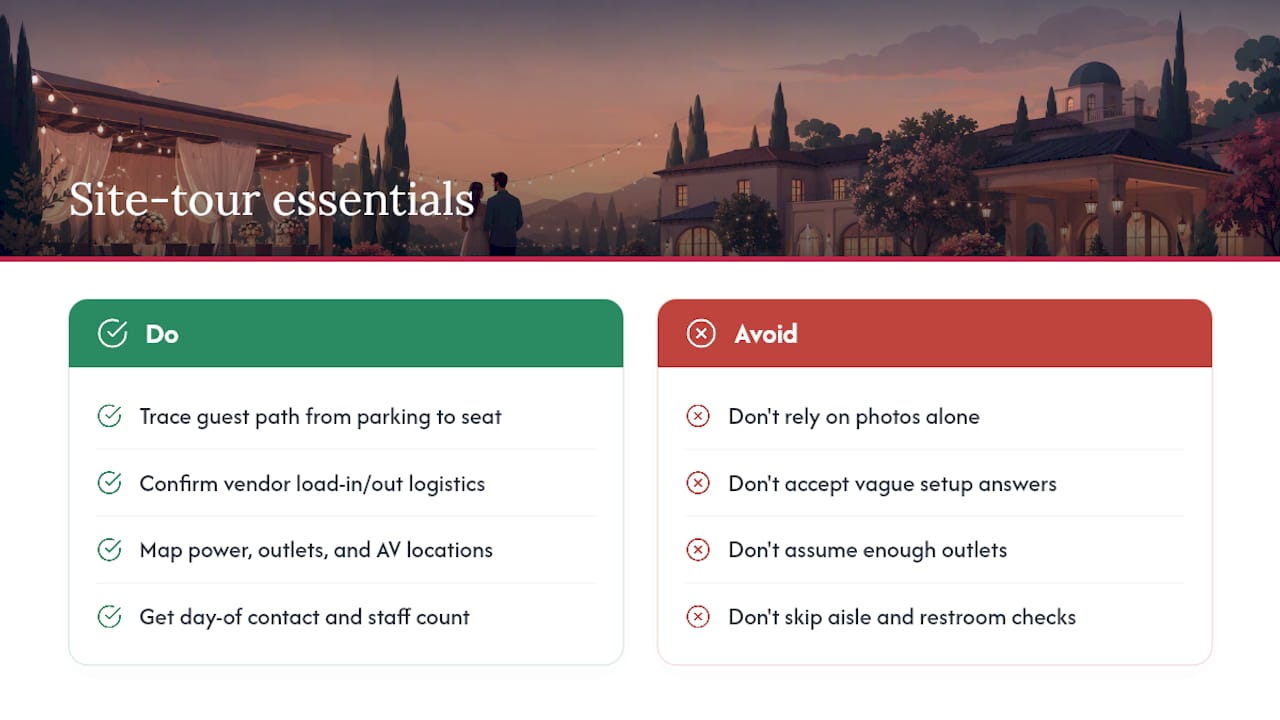
1. Walk the guest flow from parking to seat. Trace the path a guest would take: where they park, where they enter, and where they sit for the ceremony. Check aisle width, sightlines from the back row, and whether the reception layout leaves room for a dance floor without guests having to relocate tables mid-event.
2. Confirm load-in and load-out logistics. Ask about vendor entrances, whether there are stairs or an elevator, and exactly when vendors are allowed to start setup. A florist who needs three hours and a caterer who needs a loading dock both need concrete answers, not a vague “we’ll figure it out.”
3. Map the power and AV situation. Ask how many outlets are available and where, whether the venue provides speakers or microphones, and where a DJ or band would set up relative to the outlets. This single question prevents more day-of scrambling than almost any other item on your list.
4. Count the restrooms and check accessibility. For 100+ guests, two restrooms often means a line during cocktail hour. Photograph the distance from parking to the entrance, since that detail matters for guests with mobility needs, elderly relatives, or anyone in heels crossing gravel.
5. Ask who’s actually working your wedding. Get a name, not a job title. Ask who your on-site contact will be the day of, how many staff members are typically scheduled for an event your size, and what happens if something goes wrong mid-reception. “We’ll have someone there” is not an answer.
Pro Tip: Bring a tape measure and your phone’s voice memo app. Walk the ceremony aisle and dictate notes as you go (“aisle is about 4 feet, tight for a wheelchair”) instead of trying to remember every detail after five venue tours start blurring together.
Practical Wedding’s site-visit guidance leans hard on exactly these operational checks, and for good reason: a venue’s charm rarely changes between your first look and your wedding day, but its power capacity, restroom count, and staffing levels are what actually determine whether the event runs smoothly. These are the questions to ask wedding venues that separate a venue coordinator who has walked this exact ground a hundred times from one who is guessing right alongside you.
Getting the Real Cost in Writing Before You Fall in Love With a Venue
The advertised rental fee is rarely the number you’ll actually pay. Ask for the full total for your specific date and guest count in writing, not a base price that sounds appealing until you add tables, linens, overtime, and a security deposit.
Start with the deposit structure. How much is due to hold the date, what’s the full payment schedule, and what happens to your deposit if you need to cancel or postpone? Ask whether the venue offers any price guarantee, since some properties raise rates seasonally or year over year, and you want to know if your quote is locked in the day you sign.
Minted’s venue checklist identifies “what is not included in the rental fee” as the single most overlooked question couples fail to ask, and the venues that stay vague about it are often the ones with the biggest gap between quote and final invoice. Overtime fees, service charges, sales tax, and security deposits routinely add hundreds or thousands of dollars to a number that looked reasonable on a brochure.
Before you sign anything, get clear answers on:
The full itemized total for your date and guest count, not just the base rental price
Deposit amount, payment schedule, and the exact refund or cancellation policy
Overtime fees if your event runs past the contracted end time
Whether service charges and gratuities are included, and who actually receives them
Extra costs for vendor fees, corkage, generators, tenting, or rain-plan backup
Ask for a copy of the full contract, not a summary, and read it before you sign. Watch for escalation clauses that let the venue raise fees after booking, and vague refund language that doesn’t specify exact dollar amounts or timelines. If a venue’s answers about pricing shift depending on who you ask, or if the contract language contradicts what the tour guide told you verbally, treat that as a reason to slow down, not a detail to smooth over later.
Getting an itemized sample quote before your visit, as recommended by WithJoy’s venue checklist, means you walk into the tour already knowing roughly where you stand financially. That frees you up to focus on the space itself instead of doing math in your head while someone shows you the bridal suite.
Food, Bar, and Vendor Rules That Change Your Budget Fast
Catering and bar policies are where a reasonable-looking budget can quietly double. If the venue requires in-house catering, ask for full menu options, whether tastings are included in your package, and whether there’s a food and beverage minimum you’re required to hit regardless of your actual guest count.
If outside catering is allowed, confirm kitchen access. Some venues have a full commercial kitchen; others offer a bare room with no refrigeration or prep space, which changes what your caterer can realistically deliver and may add rental costs for warming equipment.

Bar policies deserve the same scrutiny. Ask whether the venue requires a licensed bartender, whether you can bring your own alcohol, and what corkage fees apply if you do. Some venues charge a flat bar package per guest; others charge by consumption, and the difference matters enormously for a wedding with an open bar.
Vendor logistics round this out:
Does the venue require a certificate of insurance (COI) from every outside vendor, including your florist and DJ?
Is there a preferred-vendor list, and are you required to use it or is it just a recommendation?
Can your vendors arrive the night before to set up, or is everything limited to a same-day window.
Is there a dedicated space for vendors to stage equipment and supplies out of guest sightlines?
Venues that maintain a recommended vendor list usually do it because those vendors already know the property’s quirks: where the power runs, how far the load-in is, and what the venue’s setup timeline actually allows. That familiarity often means fewer surprises on your wedding day.
Decor and Rental Rules: What You Can Bring and Who Pays for Damage
Every venue has a written policy on open flame, sparklers, confetti, and hanging decor from ceilings or rafters, and it’s rarely as flexible as a Pinterest board suggests. Ask for that policy in writing rather than a verbal “we usually allow it,” since verbal permissions have a way of disappearing when something gets scorched or stained.
Confirm exactly which rentals come with your package. Tables, chairs, linens, and dishware are often included at some venues and billed separately at others, and the difference between those two setups can shift your budget by thousands of dollars.
Ask these decor and rental questions directly:
What’s the written policy on candles, sparklers, confetti, and hanging installations?
Which tables, chairs, linens, and dishware are included, and which require an outside rental?
Who handles decor setup and breakdown, and is there a fee if the venue’s staff does it for you?
What’s the damage deposit amount, and what’s the process if something gets accidentally damaged?
A rustic barn setting invites string lights, greenery, and candlelit tablescapes, but every one of those touches needs a clear yes from the venue before it becomes part of your plan.
The Final Walkthrough: Questions That Should Come Right Before You Sign
Your final walkthrough is your last chance to catch a problem before it becomes a contract you’re locked into. Confirm your arrival window on the wedding day itself, who from the venue’s staff will be on-site, and whether a rehearsal walkthrough is included in your package or billed separately.
Verify the site map. Confirm exact locations for vendor deliveries, parking for guests versus vendors, and where trucks or vans will load in without blocking guest arrival.
Ask for every verbal promise in writing. If a coordinator agreed to a late load-in or a fee waiver during your tour, get it added as a dated addendum to the contract before you sign anything.
Watch for evasive answers. A venue that gives inconsistent numbers for capacity, dodges direct pricing questions, or can’t produce a written policy on something you’ve asked twice is showing you a red flag, not an oversight.
Check for safety and facility gaps. Insufficient restrooms, unclear emergency exits, or a coordinator who can’t explain the backup rain plan are reasons to pause, not push forward.
If the answers you get during this final meeting contradict what you heard during your first tour, trust the contract over the conversation, and don’t sign until the discrepancy is resolved in writing.
Turning Your Notes Into a Real Decision: Photos, Measurements, and a Simple Scoring System
A tour is only useful if you can compare it fairly against the next one, and memory fades fast after your third or fourth venue visit. Photograph outlet locations, count restrooms, measure the distance from parking to the entrance, and capture ceremony sightlines from the back row, not just the front.
A simple three-tier scoring system, adapted from the approach WedStay recommends, keeps decisions clear: mark anything unfixable as a deal-breaker, mark negotiable items separately, and mark nice-to-haves last. Eliminate deal-breaker venues immediately, then rank the rest by total out-the-door cost for your actual date.
Photograph outlets, restroom locations, and parking-to-entrance distance at every venue you tour.
Request an itemized sample quote from each finalist so you’re comparing true totals, not advertised base rates.
Ask any venue for real-wedding photos and a sample contract, not just styled marketing shots, before you rank it.
Pro Tip: Lay your itemized quotes side by side in a simple spreadsheet with rows for date, capacity, base fee, add-ons, and total cost. Venues that look similar on price often reveal a $2,000 gap once fees are itemized the same way.
Mountain View Menagerie’s wedding packages list included decorations, seating, and inclusions upfront, which is the exact kind of documentation worth requesting from any venue you’re seriously considering.
Where Your Out-of-Town Guests Will Stay
A stunning barn venue in the countryside often means your guests are staying somewhere other than walking distance, so accommodation planning deserves a spot on your tour questions, too. Ask the venue whether they have a list of recommended hotels, bed-and-breakfasts, or vacation rentals nearby, and whether any local properties offer a wedding room block or discounted group rate.
Distance matters more than it seems on a map. A hotel that’s technically “20 minutes away” during a weekday can be 40 minutes with wedding-weekend traffic or a mountain road at night, so ask the venue’s staff for their honest, practical estimate rather than relying on GPS alone. If your venue is rural, confirm whether rideshare services reliably operate in the area, since some couples end up arranging a shuttle or block of rooms specifically because cell service and rideshare coverage are thin.
Ask whether the venue can recommend a range of price points, since your guest list likely includes both budget-conscious college friends and relatives who’d rather book a nicer stay. A venue that has hosted dozens of weddings usually has this answer ready without hesitation, because they’ve fielded the same question from every couple before you. If they seem unprepared for it, that’s worth noting alongside your other tour observations.
Finally, ask about parking or shuttle options for guests staying off-site, especially if your ceremony and reception are in a rural setting without sidewalks or streetlights. A simple shuttle schedule from the main accommodation cluster to the venue solves a logistics problem before it becomes one.
What Venue Staff Actually Wish Couples Would Ask
Most of the policies that frustrate couples during planning exist for reasons that have nothing to do with being difficult. Insurance requirements, vendor restrictions, and setup time limits usually trace back to safety, liability, or a staffing schedule that can’t stretch infinitely without extra cost.
Couples who ask specific, detailed questions, and who ask for those answers in writing, almost always have a smoother planning experience than couples who accept vague reassurances and hope it works out. A venue that’s proud of its policies will explain them clearly; one that dodges the question is telling you something too.
After your tour, the smartest next move is requesting a sample contract and connecting your vendors directly with the venue’s coordinator. That single conversation between your florist or DJ and the venue staff catches logistical mismatches weeks before they’d otherwise surface on your wedding morning.
— James
Touring Mountain View Menagerie: What to Expect on Your Visit
A barn venue gives straightforward answers to most of the questions above before you even ask them, and some venues include decorations, seating, tables, linens, bridal suites, and groom’s lounges as part of their packages, so you can compare real totals rather than piecing one together from add-on fees.
Both indoor and outdoor ceremony options are available on-site, which means you get a built-in rain plan without scrambling to find a tent vendor two weeks before your wedding. The Colorado barn wedding packages page lays out what’s included so you can see, in writing, exactly what a sample quote looks like before you tour. That kind of upfront documentation is worth requesting from any venue on your list. It’s the same standard this article has walked you through applying everywhere else.
If you’re ready to see the mountain views and barn setting in person, you can book your tour directly and bring your own checklist, questions, and measuring tape along with you.
Printable Checklists and Sample Contract Resources Worth Downloading
Bring a printed checklist to every tour, and request a sample contract before you finalize any booking. Several established resources cover these categories in more depth if you want a physical copy to bring along.
The Knot’s 64-question checklist, organized by tour phase from initial call to final meeting
A Practical Wedding’s site-visit questions, strong on operational and red-flag guidance
WithJoy’s 50+ question checklist, broad coverage of pricing and vendor terms
Sources
FAQ
What is the 50/20/30 rule for weddings?
It’s a rough budget-allocation guideline some planners use, generally putting the largest share, around half, toward venue and catering, with smaller portions for attire, photography, and other categories. Treat it as a starting framework, not a fixed rule, since actual splits vary widely by region and guest count.
What is the 30 minute rule for weddings?
It refers to the idea that no single part of your reception, like speeches, dinner service, or vendor setup, should run more than a typical short time without a shift in pace, to keep guests engaged. Ask your venue coordinator how their standard timeline paces these transitions during your final walkthrough.
What should you ask at your final venue walkthrough?
Confirm your arrival window, who’s on-site staff that day, whether the rehearsal is included, and get any verbally negotiated items added as a written, dated addendum to your contract. This is also your last chance to verify the vendor site map and flag any answers that contradict what you heard on your first tour.
What should you wear to tour a wedding venue?
Comfortable, closed-toe shoes matter most, since you’ll likely walk gravel, grass, or uneven flooring while checking sightlines and measuring distances. Dress like you’re viewing a property, not attending an event, so you can move freely and take notes without worrying about your outfit.
Recommended
Comments